Diplomacy
Shah’s UN speech draws coverage from major international media outlets
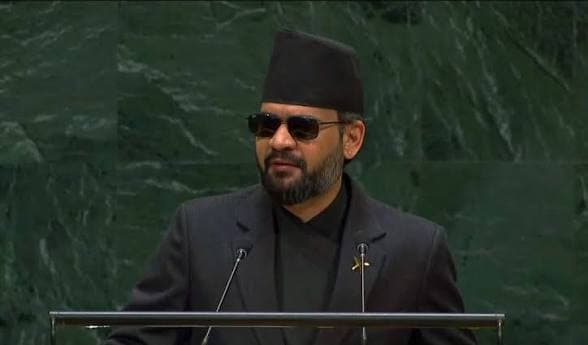
The international attention came as Shah used his first major appearance at the UN to place Nepal’s climate vulnerability and the August floods at the centre of his foreign-policy message.
Kathmandu Affairs
Kathmandu, September 26
Prime Minister Balendra Shah’s address to the 81st United Nations General Assembly has received coverage from a wide range of international media outlets, with reports focusing mainly on Nepal’s devastating floods, climate change and Shah’s call for climate justice and international support.
The coverage has appeared across international news agencies, broadcasters and newspapers in North America, Europe, Asia, Australia and the Middle East.
According to a compilation of media reports, 36 unique media outlets have so far carried reports or coverage related to Shah’s UNGA address.
The list includes major international news agencies such as Associated Press (AP), Reuters, Agence France-Presse (AFP), UNifeed, Xinhua, PTI, ANI and IANS, as well as broadcasters including Deutsche Welle, Al Jazeera, France 24, BBC News Hindi and SBS Australia.
Major newspapers and digital outlets that carried coverage include The New York Times, The Guardian, The Independent, USA Today, The Seattle Times, The Times of India, Hindustan Times, NDTV, India Today, The Korea Times, Arab News, bdnews24 and The Observer of Bangladesh.
Nepal’s The Kathmandu Post also published extensive coverage of Shah’s first address to the UN General Assembly as prime minister.
The international coverage largely centred on Shah’s warning that Nepal’s recent floods were a consequence of a wider climate crisis and his appeal for greater international support for vulnerable countries.
The Guardian reported Shah’s description of the floods as a “warning to the world” and highlighted his call for grant-based support for Nepal’s recovery and reconstruction.
Reuters and other major agencies also highlighted Shah’s argument that climate-vulnerable countries should not be forced to accumulate additional debt to rebuild after climate-related disasters.
Another prominent element of the coverage was Shah’s proposal for a Himalayan Climate Resilience Mechanism involving Nepal, India and China. The proposed mechanism would facilitate satellite-data sharing, monitoring of glacial lakes, early-warning systems and coordination in responding to disasters across borders.
Some outlets also focused on Shah’s public image and his appearance at the UN, including his trademark dark glasses and traditional Nepali topi. The New York Times, for instance, published a separate report focusing on his sunglasses and public persona.
The international attention came as Shah used his first major appearance at the UN to place Nepal’s climate vulnerability and the August floods at the centre of his foreign-policy message.
The Ministry of Foreign Affairs has published the full text of Shah’s September 24 address, in which he linked the destruction caused by the floods to the broader climate crisis and called for greater international action.
The coverage spans 36 outlets in the compilation provided, including UNifeed, AP, Reuters, AFP, DW, Al Jazeera, France 24, Xinhua, China Daily, PTI, ANI, IANS, The Kathmandu Post, The New York Times, The Seattle Times, The Times of India, Hindustan Times, NDTV, The Statesman, ThePrint, Times Now, News18, India Today, Daily Pioneer, DNA India, The Wire, bdnews24, The Observer, The Korea Times, SBS, The New Daily, The Guardian, The Independent, BBC News Hindi, USA Today and Arab News.
Stay Informed
Get the daily briefing delivered to your inbox.
Discussion
Member comments are coming soon. Join today to get notified when the conversation opens.
Related Stories
